Introduction
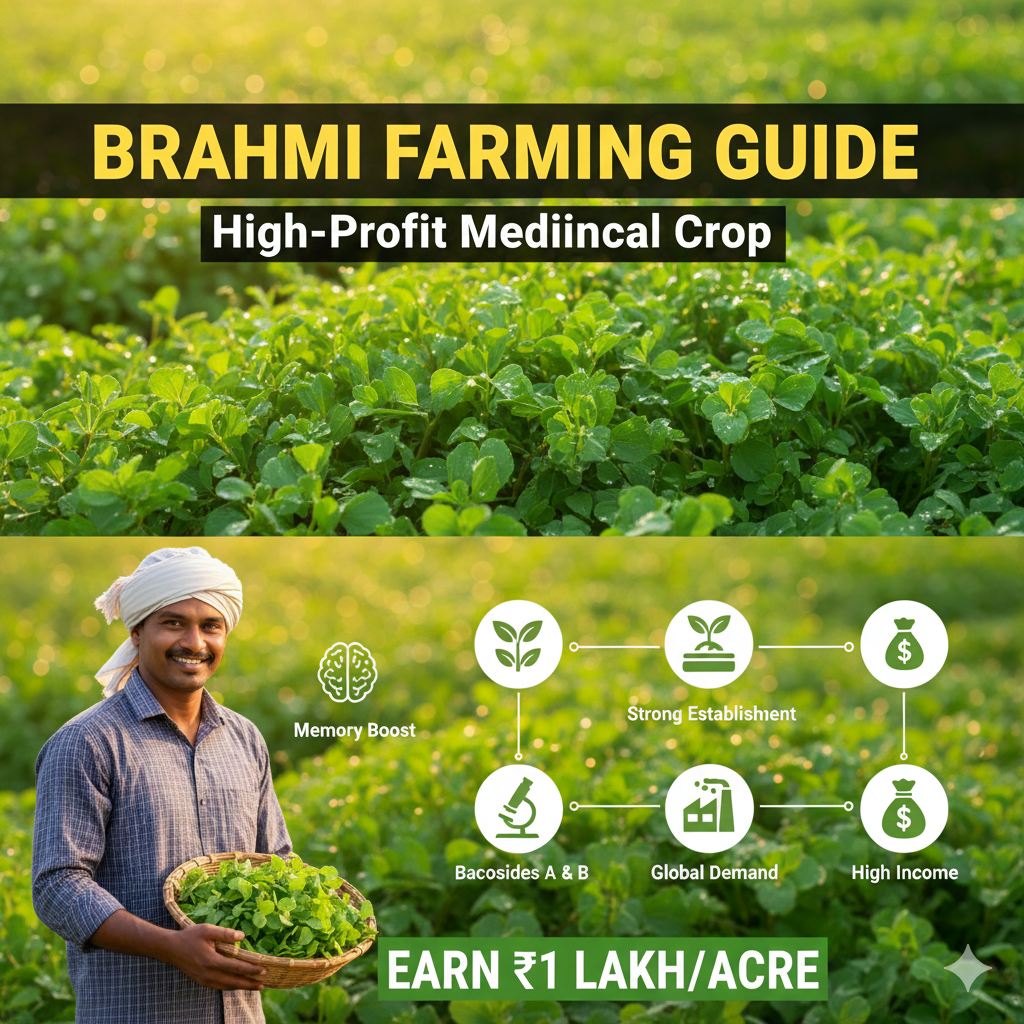
Brahmi (Bacopa monnieri), commonly known as Jal Brahmi or Water Hyssop, is one of the most important medicinal herbs used in Ayurveda, Siddha, and Unani systems of medicine. Brahmi is globally recognized for its powerful role in improving memory, concentration, learning ability, and mental clarity. Its active compounds, mainly Bacosides A and B, are scientifically proven to support brain health, reduce anxiety, and enhance cognitive performance.
In India, Brahmi has been traditionally used for centuries as a Medhya Rasayana (brain tonic). With the rapid growth of ayurvedic, herbal, pharmaceutical, and nutraceutical industries, the demand for Brahmi raw material has increased significantly. Today, Brahmi crop farming has emerged as a high‑value, low‑risk medicinal farming option suitable for small, marginal, and commercial farmers.
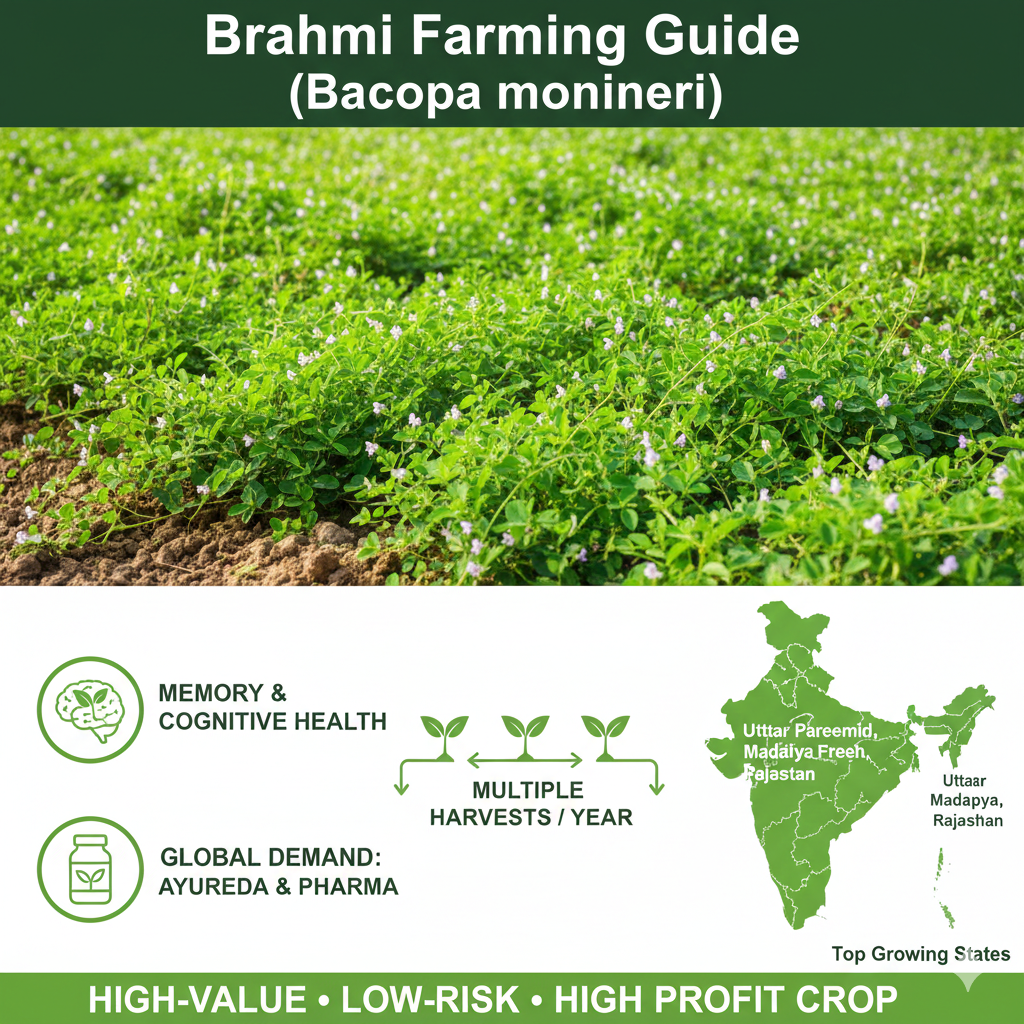
Brahmi is a perennial, creeping, moisture‑loving herb that allows multiple harvests in a year, ensuring regular income. With proper irrigation, nutrient management, and timely harvesting, farmers can achieve stable yields and attractive profits from Brahmi cultivation.
Brahmi Crop Farming in India
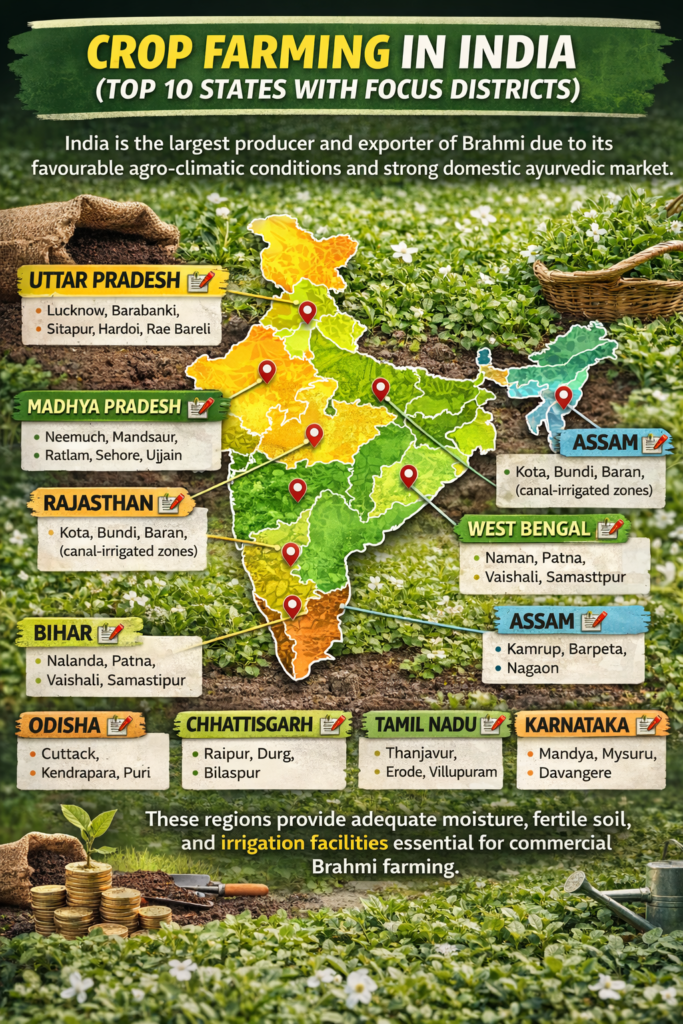
India is the largest producer and exporter of Brahmi due to its favorable agro‑climatic conditions and strong domestic ayurvedic market.
- Uttar Pradesh – Lucknow, Barabanki, Sitapur, Hardoi, Rae Bareli
- Madhya Pradesh – Neemuch, Mandsaur, Ratlam, Sehore, Ujjain
- Rajasthan – Kota, Bundi, Baran (canal‑irrigated zones)
- Bihar – Nalanda, Patna, Vaishali, Samastipur
- West Bengal – Nadia, Murshidabad, Hooghly
- Assam – Kamrup, Barpeta, Nagaon
- Odisha – Cuttack, Kendrapara, Puri
- Chhattisgarh – Raipur, Durg, Bilaspur
- Tamil Nadu – Thanjavur, Erode, Villupuram
- Karnataka – Mandya, Mysuru, Davangere
These regions provide adequate moisture, fertile soil, and irrigation facilities essential for commercial Brahmi farming.
Brahmi Crop Farming in Top Countries
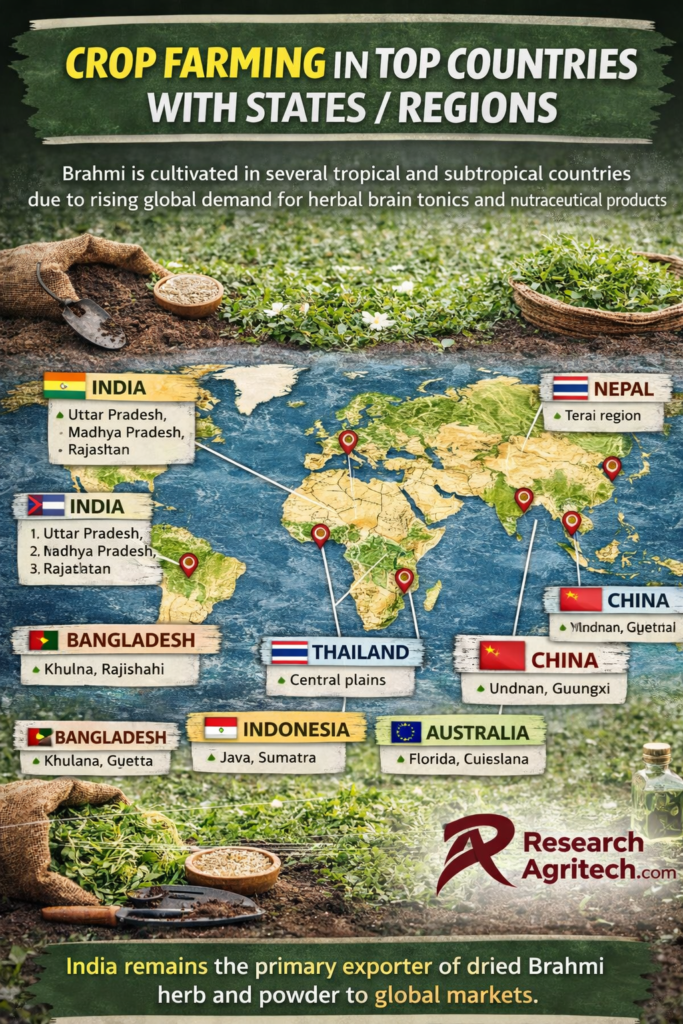
Brahmi is cultivated in several tropical and subtropical countries due to rising global demand for herbal brain tonics and nutraceutical products.
- India – Uttar Pradesh, Madhya Pradesh, Rajasthan
- Nepal – Terai region
- Sri Lanka – Western and Southern provinces
- Bangladesh – Khulna, Rajshahi
- Thailand – Central plains
- Vietnam – Mekong Delta
- China – Yunnan, Guangxi
- Indonesia – Java, Sumatra
- Australia – Queensland
- United States – Florida, Louisiana
India remains the primary exporter of dried Brahmi herb and powder to global markets.
Brahmi Crop Optimal Time for Cultivation
Brahmi can be cultivated throughout the year under irrigated conditions. However, the best planting seasons are:
- Zaid season: February–March
- Kharif season: June–July
Moderate temperature and assured moisture during planting ensure quick establishment and vigorous growth. Extreme winters and severe heat should be avoided.
Brahmi Crop Climate and Weather Requirements
- Temperature: 18°C to 35°C
- Rainfall: 600–2500 mm annually
- Humidity: High humidity preferred
Brahmi thrives in warm and humid climates and can tolerate partial waterlogging. Frost conditions and prolonged drought negatively affect growth and yield.
Brahmi Crop Field Preparation
- Plough the land 2–3 times to obtain fine tilth
- Remove weeds, roots, and crop residues
- Level the field properly to retain moisture
- Apply 8–10 tons of well‑decomposed FYM per acre
- Prepare flat beds or raised beds depending on drainage
Good land leveling is critical for uniform moisture distribution.
Brahmi Crop Soil Requirements
- Soil type: Loamy, clay loam, sandy loam
- Soil pH: 5.5–7.5
- Organic matter: High
Moisture‑retentive and fertile soils produce higher biomass and better bacoside content.
Top 10 Best Varieties of Brahmi
(Corrected logically for Brahmi crop)
- CIM‑Jagriti
- CIM‑Medha
- Anand Brahmi‑1
- Anand Brahmi‑2
- Kashi Brahmi
- IC‑46963
- IC‑39552
- Local Green Brahmi
- Local White Brahmi
- Wild Bacopa Selection
These varieties are selected for high biomass yield and superior bacoside concentration.
Brahmi Crop Planting Density and Spacing
- Spacing: 30 cm × 30 cm
- Planting material: Stem cuttings / rooted slips
- Plant population: 15,000–18,000 plants per acre
Vegetative propagation ensures uniform crop stand and faster establishment.
Brahmi Crop Fertilizer Management
Primary Nutrients
- Nitrogen (N): 40–50 kg/acre (split after each harvest)
- Phosphorus (P₂O₅): 20–25 kg/acre (basal)
- Potash (K₂O): 20–25 kg/acre (basal)
Secondary Nutrients
- Calcium: Improves root and stem strength
- Magnesium: Enhances chlorophyll formation
- Sulphur: 8–10 kg/acre
Micronutrients
- Zinc (Zn)
- Iron (Fe)
- Boron (B)
- Manganese (Mn)
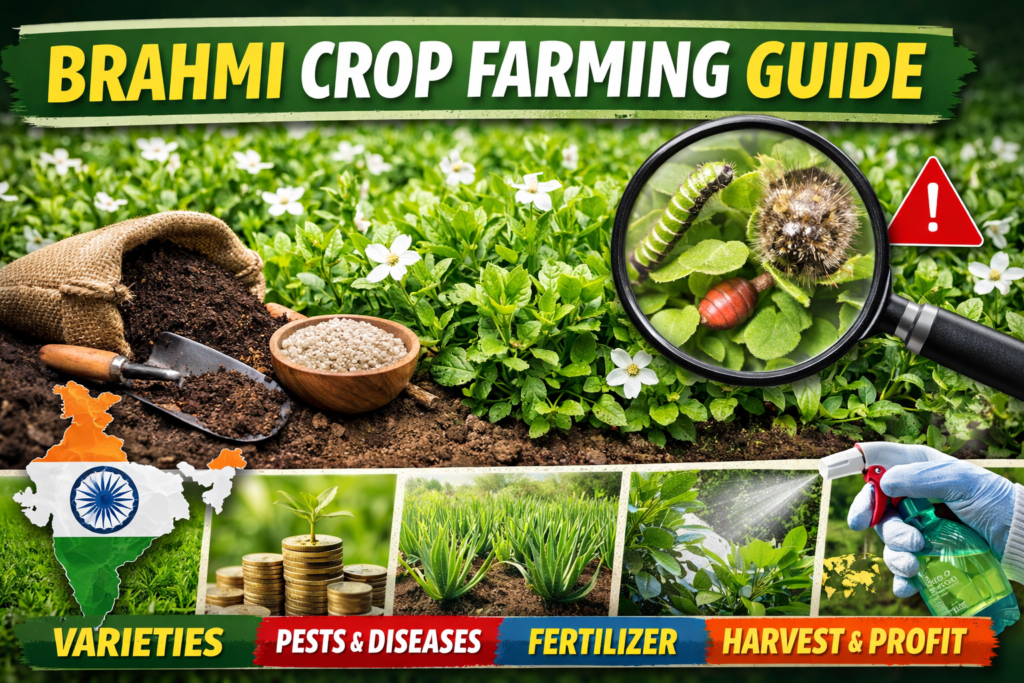
Micronutrients should be applied through foliar spray 2–3 times per year.
Brahmi Crop Weeds and Management
- Cyperus rotundus – Hand weeding
- Echinochloa spp. – Mulching
- Amaranthus viridis – Manual removal
- Parthenium hysterophorus – Uprooting
- Chenopodium album – Hoeing
- Portulaca oleracea – Hand weeding
- Commelina benghalensis – Mulching
- Digitaria sanguinalis – Intercultivation
- Eleusine indica – Field sanitation
- Phalaris minor – Manual control
Top 10 Insects and Control
| Insect | Chemical Control | Biological Control |
|---|---|---|
| Aphids | Imidacloprid, | Neem oil |
| Whitefly | Thiamethoxam | Yellow sticky traps |
| Thrips | Spinosad | Neem extract |
| Mealybug | Imidacloprid | Cryptolaemus beetle |
| Leaf miner | Abamectin | Neem oil |
| Caterpillar | Cypermethrin | Bt formulation |
| Grasshopper | Quinalphos | Mechanical control |
| Termites | Chlorpyrifos | Neem cake |
| Mites | Wettable sulphur | Predatory mites |
| Cutworm | Chlorpyrifos | Soil solarization |
Brahmi Crop Diseases and Control
| Disease | Chemical Control | Biological Control |
| Leaf spot | Mancozeb | Pseudomonas fluorescens |
| Root rot | Carbendazim | Trichoderma viride |
| Powdery mildew | Sulphur | Neem extract |
| Damping‑off | Metalaxyl | Trichoderma |
| Stem rot | Copper fungicide | Trichoderma |
| Leaf blight | Chlorothalonil | Pseudomonas |
| Rust | Propiconazole | Sulphur spray |
| Wilt | Carbendazim | Crop rotation |
| Bacterial leaf spot | Copper oxychloride | Neem extract |
| Mosaic virus | No chemical | Rogue infected plants |
Brahmi Crop Harvesting and Yield
- First harvest: 60–75 days after planting
- Subsequent harvests: Every 45–60 days
- Method: Cut aerial parts 5–7 cm above ground
Under good management, 3–4 harvests per year are possible.
Brahmi Crop Production Per Acre
- Fresh biomass: 8–10 tons/year
- Dry herb yield: 2–2.5 tons/year
Yield depends on variety, nutrition, irrigation, and harvest interval.
Conclusion
Brahmi crop farming is a highly profitable, sustainable, and future‑ready medicinal farming option for Indian farmers. With strong demand from ayurvedic, pharmaceutical, and nutraceutical industries, Brahmi offers assured market potential. Adoption of scientific cultivation practices, balanced nutrient management, and integrated pest management can help farmers achieve consistent yields and long‑term income stability.
Brahmi Crop Farming FAQs
Q1. What is Brahmi crop?
Ans: Brahmi (Bacopa monnieri) is a medicinal herb widely used in Ayurveda for brain and nerve health.
Q2. Which climate is best for Brahmi cultivation?
Ans: Warm, humid, and tropical to subtropical climate with 25–35°C temperature is ideal for Brahmi.
Q3. What type of soil is suitable for Brahmi farming?
Ans: Moist, fertile loamy or clay loam soil with good water-holding capacity is best.
Q4. When is the best time to plant Brahmi?
Ans: June to July during the monsoon season is the best time for planting Brahmi.
Q5. How is Brahmi propagated?
Ans: Brahmi is mainly propagated through stem cuttings and root divisions.
Q6. What is the spacing recommended for Brahmi crop?
Ans: A spacing of 20 × 20 cm ensures healthy growth and higher biomass yield.
Q7. How much water does Brahmi crop need?
Ans: Brahmi requires regular light irrigation to maintain continuously moist soil.
Q8. What is the fertilizer requirement for Brahmi?
Ans: Balanced use of FYM, nitrogen, phosphorus, potassium, and micronutrients improves yield.
Q9. Is Brahmi suitable for organic farming?
Ans: Yes, Brahmi is highly suitable for organic cultivation using biofertilizers and biopesticides.
Q10. Which weeds commonly affect Brahmi crop?
Ans: Nut grass, barnyard grass, amaranthus, and purslane are common weeds in Brahmi fields.
Q11. What are major insect pests of Brahmi?
Ans: Aphids, leaf miners, caterpillars, and mites are major insect pests.
Q12. How to control pests in Brahmi organically?
Ans: Neem oil spray, Trichoderma, and biological predators help control pests naturally.
Q13. What diseases commonly occur in Brahmi farming?
Ans: Root rot, leaf spot, powdery mildew, and damping-off are common diseases.
Q14. How long does Brahmi crop take to harvest?
Ans: Brahmi is ready for first harvest within 90–120 days after planting.
Q15. How many harvests are possible in Brahmi crop?
Ans: 3 to 4 cuttings can be taken in a year under good management.
Q16. What is the average yield of Brahmi per acre?
Ans: Average fresh biomass yield ranges from 8 to 10 tons per acre annually.
Q17. What is the market demand for Brahmi?
Ans: Brahmi has high demand in Ayurvedic, pharmaceutical, and herbal industries.
Q18. Is Brahmi farming profitable?
Ans: Yes, Brahmi farming offers high returns due to low input cost and strong medicinal demand.
Q19. Can Brahmi be intercropped?
Ans: Yes, Brahmi can be intercropped with medicinal and vegetable crops in moist fields.
Q20. Which states in India are best for Brahmi cultivation?
Ans: Uttar Pradesh, Madhya Pradesh, Bihar, West Bengal, Tamil Nadu, and Assam are ideal states.
Writer- Durgaprasad Kewte