Introduction
Weed infestation is one of the most critical challenges in sugarcane cultivation. Weeds compete aggressively with the crop for nutrients, water, sunlight, and space, especially during early growth stages. If not controlled timely, weeds can reduce cane yield significantly and increase production costs due to repeated manual weeding. The problem becomes more severe with hard-to-control weeds like Cyperus rotundus (Nut grass/Motha), which spreads rapidly through underground tubers.
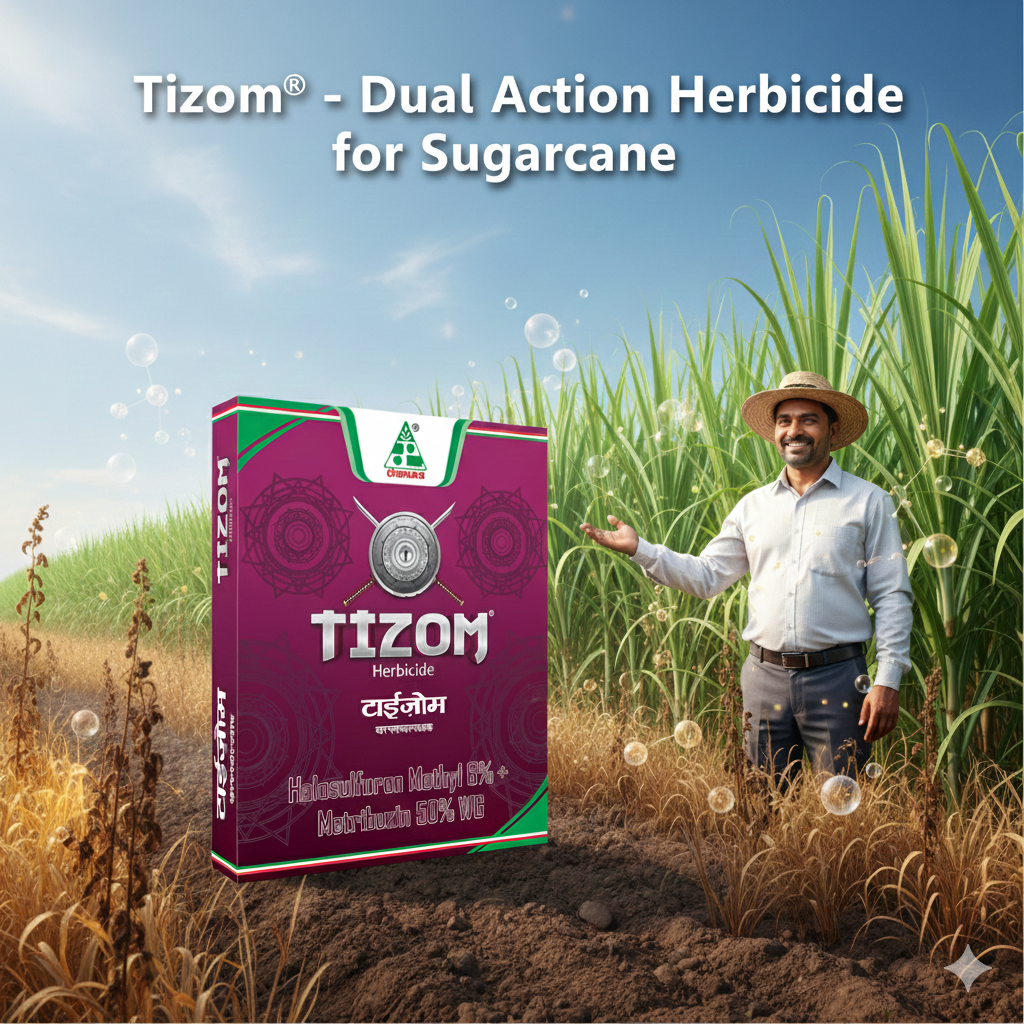
To overcome these challenges, modern agriculture requires research-based, selective, and systemic herbicides that provide long-lasting and broad-spectrum weed control without affecting the crop. Tizom® Herbicide, developed jointly by Dhanuka Agritech Limited and Nissan Chemicals, Japan, is a next-generation herbicide specifically designed for effective post-emergence weed management in sugarcane.
Product Name
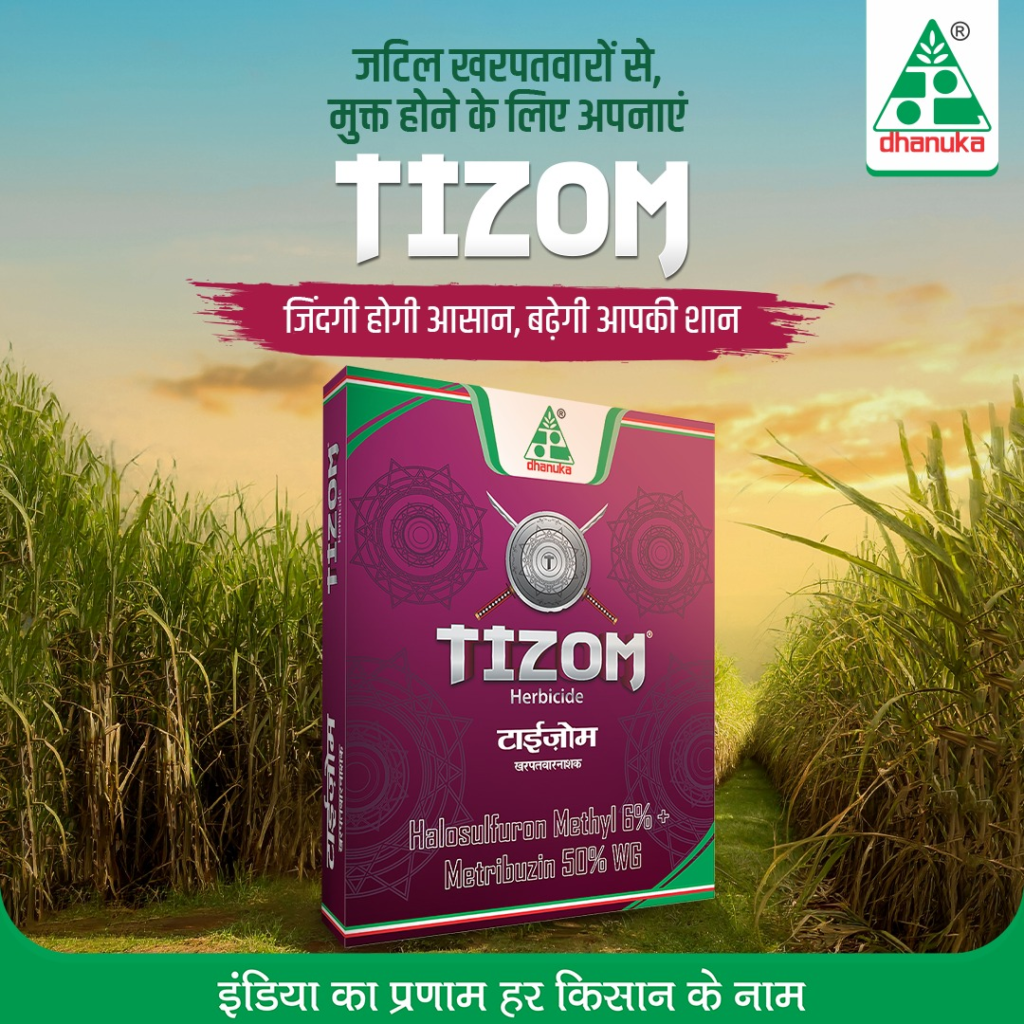
Tizom® Herbicide
Company Name
Dhanuka Agritech Limited
(Jointly developed with Nissan Chemicals, Japan)
Product Content (Technical Composition)
Halosulfuron Methyl (6%) + Metribuzin (50%) WG
- Halosulfuron Methyl (6%) – Controls sedges and broad-leaf weeds by inhibiting ALS enzyme
- Metribuzin (50%) – Controls grassy and broad-leaf weeds by blocking photosynthesis
This powerful combination ensures dual-pathway weed control, long residual activity, and effective resistance management.

Product Technology
Dual-Action Selective Systemic Herbicide Technology
Tizom® is formulated as a WG (Water Dispersible Granule) and works through two different biochemical pathways, making it highly effective and reliable.
- Systemic movement both acropetally and basipetally
- Translocated through xylem and phloem
- Targets weeds without harming sugarcane
- Helps delay herbicide resistance development
Pack Size
- 225 g
- 450 g
Key Features & Benefits
- Dual-action herbicide with two distinct modes of action
- Broad-spectrum control of BLWs, NLWs, and sedges
- Highly effective against Cyperus rotundus (Nut grass)
- Selective and safe for sugarcane crop
- Systemic action ensures complete weed kill
- Effective post-emergence herbicide
- Provides extended residual weed control
- Reduces early crop-weed competition
- Enhances nutrient and moisture availability to sugarcane
- Improves crop growth and cane yield
- Cost-efficient weed management solution
- Better net returns to farmers
- Moderate rain fastness for stable performance
- Reduces dependency on manual weeding
- Backed by Indo-Japanese research expertise
How Tizom® Herbicide Works
Tizom® Herbicide works through a dual biochemical mechanism, targeting weeds at different physiological processes to ensure effective and long-lasting control.
- Halosulfuron Methyl inhibits the enzyme Acetolactate Synthase (ALS), which is responsible for the synthesis of essential branched-chain amino acids such as valine, leucine, and isoleucine. When this enzyme is blocked, protein synthesis in weeds stops, leading to growth arrest and gradual death. This action is particularly effective against sedges and broad-leaf weeds.
- Metribuzin blocks Photosystem II in the photosynthesis process. By interrupting electron transport, it prevents the weed plant from converting sunlight into usable energy. This results in energy starvation, chlorosis, and eventual weed death.
Together, these actions provide:
- Rapid suppression of weed growth
- Control of existing weeds
- Residual control of newly emerging weeds
This dual mode of action enhances weed control efficiency and helps delay resistance development.
Control Weeds
Tizom® effectively controls major weeds in sugarcane, including:
Grassy Weeds (NLWs)
- Eleusine indica (Goose grass / Jangli marua)
- Digitaria sanguinalis (Crab grass / Kekra ghass)
- Brachiaria ramose (Brown top millet / Makra)
Broad-Leaf Weeds (BLWs)
- Parthenium hysterophorus (Congress grass / Gajar ghas)
- Celosia argentia (Silver cock’s comb / Safed murg)
- Alternanthera spp. (Dwarf copper leaf / Gudri sag)
Sedges
- Cyperus rotundus (Nut grass / Motha)
Applicable Crop
- Sugarcane
(Specifically formulated and recommended for sugarcane weed management.)
Dose of Application per Acre
- Tizom®: 450 g per acre
- Water Volume: 150–200 liters per acre
- Time of Application: At 3–5 leaf stage of weeds
- Method: Post-emergence foliar spray
👉 For best results, ensure no rainfall for 2–5 hours after spraying.
Best Time & Method of Application
- Apply when weeds are young and actively growing
- Maintain uniform spray coverage
- Avoid spraying during strong wind or extreme heat
- Use clean water and calibrated sprayer
- Follow recommended dose strictly
Compatibility & Safety
- Compatible with most commonly used agrochemicals
- Avoid tank mixing with strongly alkaline products
- Use gloves, mask, and protective clothing during spraying
- Store in cool, dry place away from food and feed
Conclusion
Tizom® Herbicide is a research-driven, dual-action weed management solution specially developed for sugarcane farmers. Its unique combination of Halosulfuron Methyl and Metribuzin, supported by Indo-Japanese technology, ensures effective control of broad-leaf weeds, grassy weeds, and the most problematic sedge—Cyperus rotundus. With extended residual activity, crop safety, and cost-effective performance, Tizom® helps farmers maintain weed-free fields, achieve healthier crop growth, and secure higher cane yields and profitability.
Frequently Asked Questions – Tizom® Herbicide
Q1. What is Tizom® Herbicide used for?
Ans: Tizom® is a post-emergence herbicide used to control broadleaf weeds, grasses, and sedges in sugarcane crops.
Q2. Which company manufactures Tizom® Herbicide?
Ans: Tizom® is manufactured by Dhanuka Agritech Limited in collaboration with Nissan Chemicals, Japan.
Q3. What are the active ingredients in Tizom®?
Ans: Tizom® contains Halosulfuron Methyl 6% and Metribuzin 50% in WG formulation.
Q4. Is Tizom® selective to sugarcane?
Ans: Yes, Tizom® is selective and safe for sugarcane when applied at recommended dose and stage.
Q5. What types of weeds does Tizom® control?
Ans: It controls broadleaf weeds, narrow-leaf weeds, and sedges including Cyperus rotundus.
Q6. At which stage should Tizom® be applied?
Ans: Tizom® should be applied at the 3–5 leaf stage of actively growing weeds.
Q7. What is the recommended dose per acre?
Ans: Apply 450 grams of Tizom® per acre with adequate water volume.
Q8. Is Tizom® a systemic herbicide?
Ans: Yes, Tizom® is systemic and moves both acropetally and basipetally within weeds.
Q9. How does Tizom® work in weeds?
Ans: It inhibits ALS enzyme and blocks Photosystem II, stopping amino acid synthesis and photosynthesis.
Q10. Does Tizom® control nut grass (Motha)?
Ans: Yes, Tizom® effectively controls Cyperus rotundus, one of the most difficult sedge weeds.
Q11. Is Tizom® rainfast?
Ans: Tizom® has moderate rainfastness; avoid rainfall for 2–5 hours after spraying.
Q12. Can Tizom® be mixed with other agrochemicals?
Ans: Tizom® is compatible with most agrochemicals but avoid mixing with strongly alkaline products.
Q13. Does Tizom® provide residual weed control?
Ans: Yes, it offers extended residual action for prolonged weed suppression.
Q14. Is Tizom® cost-effective for farmers?
Ans: Yes, it reduces manual weeding costs and improves net returns.
Q15. Which crops can use Tizom® Herbicide?
Ans: Tizom® is recommended specifically for sugarcane crops.
Q16. What formulation is Tizom® available in?
Ans: Tizom® is available in WG (Water Dispersible Granule) formulation.
Q17. Does Tizom® help manage herbicide resistance?
Ans: Yes, its dual mode of action helps delay herbicide resistance development.
Q18. What pack sizes are available for Tizom®?
Ans: Tizom® is available in 225 g and 450 g pack sizes.
Q19. Is protective equipment required during application?
Ans: Yes, farmers should use gloves, mask, and protective clothing during spraying.
Q20. Why should farmers choose Tizom® Herbicide?
Ans: Tizom® offers broad-spectrum weed control, crop safety, residual action, and Indo-Japanese research reliability.
Writer – Durgaprasad Kewte