Introduction
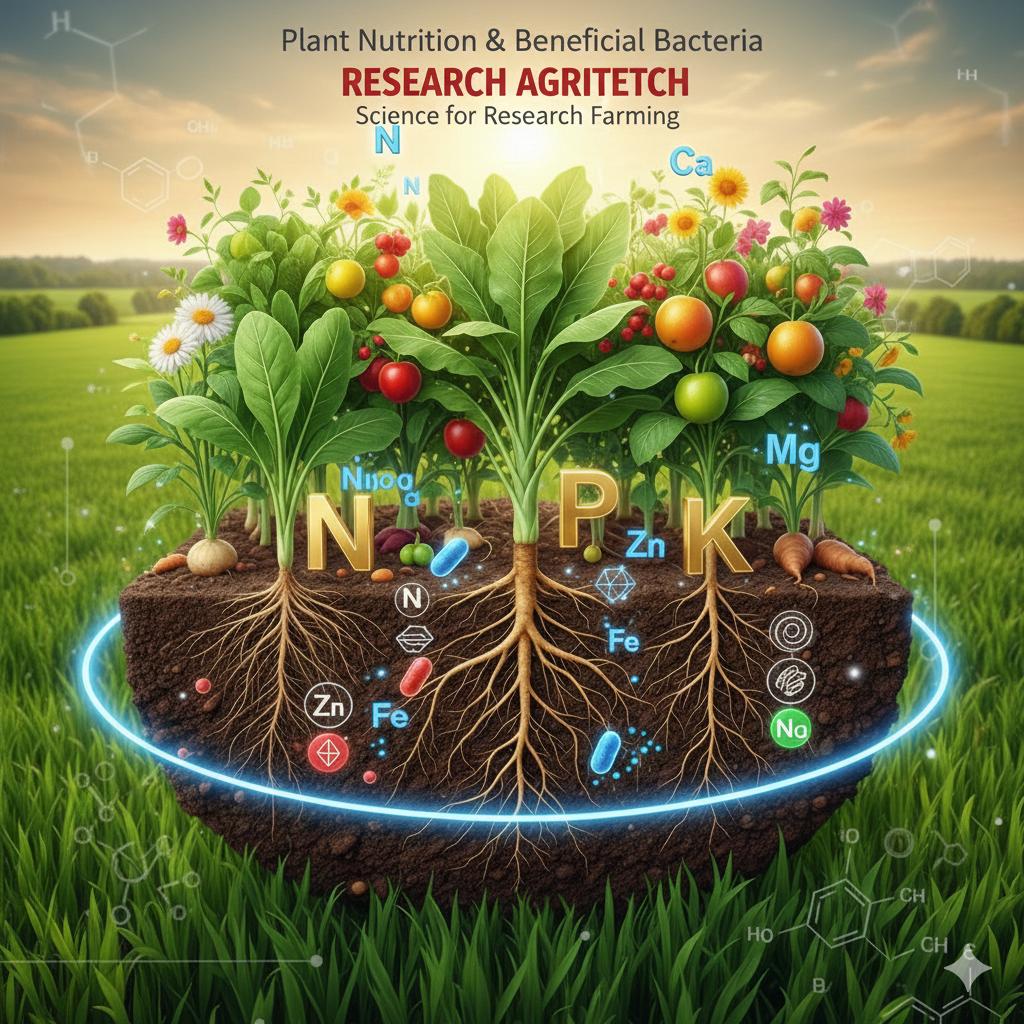
Plant nutrition is the core driver of crop productivity, quality, and sustainability. Every plant requires a balanced supply of nutrients to complete its life cycle—from seed germination and early establishment to vegetative growth, flowering, fruiting, and final yield formation. While soil may contain many nutrients naturally, most nutrients exist in unavailable or fixed forms, making them inaccessible to plant roots.
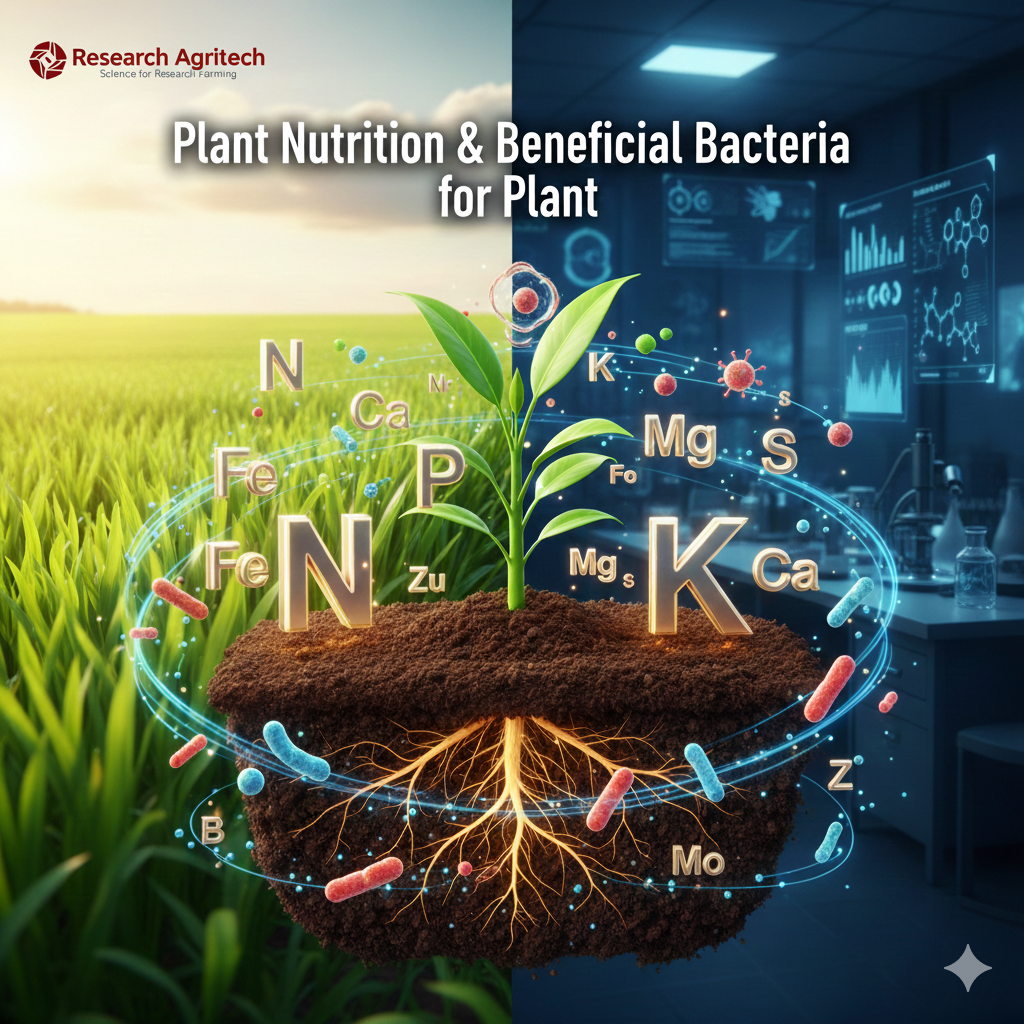
Modern agricultural science confirms that soil microorganisms—especially beneficial bacteria—are the real engines of nutrient availability. These microbes fix atmospheric nitrogen, solubilize locked phosphorus and potassium, chelate micronutrients, decompose organic matter, and regulate biochemical cycles that sustain plant growth.
Understanding which nutrient is required at which growth stage, which bacteria make it available, and how these processes function scientifically is essential for achieving high yields, reduced fertilizer cost, and long-term soil health.
This comprehensive guide explains:
- All 20 essential and beneficial plant nutrients
- The specific bacteria involved in nutrient transformation
- Their scientific mechanisms
- Their role across the crop life cycle
- How microbial nutrition supports sustainable and climate-resilient farming
Plant Nutrients & Crop Life Cycle: A Scientific Overview
Plants absorb nutrients continuously, but demand varies by growth stage:
🔹 Germination & Establishment
- Phosphorus (P)
- Calcium (Ca)
- Zinc (Zn)
- Beneficial microbes for root initiation
🔹 Vegetative Growth
- Nitrogen (N)
- Magnesium (Mg)
- Iron (Fe)
- Sulfur (S)
🔹 Flowering & Reproductive Stage
- Boron (B)
- Zinc (Zn)
- Potassium (K)
- Molybdenum (Mo)
🔹 Grain / Fruit Development & Maturity
- Potassium (K)
- Silicon (Si)
- Sulfur (S)
- Calcium (Ca)
Beneficial bacteria operate mainly in the rhizosphere (root zone), synchronizing nutrient release with plant demand.
1️⃣ Primary Macronutrients
Primary macronutrients are required in large quantities and directly influence yield.
1. Nitrogen (N) – Engine of Vegetative Growth
Importance of Nitrogen in Plants
- Core component of chlorophyll, proteins, enzymes, and nucleic acids
- Promotes leaf area, photosynthesis, tillering, and biomass
- Deficiency causes yellowing (chlorosis) and stunted growth
Nitrogen Fixing Bacteria
- Rhizobium leguminosarum
- Bradyrhizobium japonicum
- Azotobacter chroococcum
- Azospirillum brasilense
- Frankia alni
- Clostridium pasteurianum
Scientific Mechanism
- These bacteria convert atmospheric N₂ into ammonium (NH₄⁺) using the nitrogenase enzyme complex
- Symbiotic bacteria form root nodules (legumes)
- Free-living bacteria fix nitrogen independently in soil
- Associative bacteria colonize root surfaces and stimulate root growth
Role in Crop Life Cycle
- Dominant during vegetative growth
- Enhances canopy development and photosynthetic capacity
2. Phosphorus (P) – Energy Transfer & Root Architecture
Importance of Phosphorus
- Component of ATP, DNA, RNA
- Essential for root growth, flowering, seed formation
- Poor availability due to fixation in soil
Phosphate Solubilizing / Mobilizing Bacteria
- Bacillus megaterium
- Bacillus subtilis
- Pseudomonas fluorescens
- Enterobacter cloacae
- Penicillium bilaii
Scientific Mechanism
- Secretion of organic acids (gluconic, citric, lactic)
- Enzyme production (phosphatases)
- Conversion of insoluble calcium, iron, and aluminum phosphates into plant-available forms
Crop Life Cycle Role
- Critical during early root establishment and flowering
3. Potassium (K) – Stress Tolerance & Quality
Importance of Potassium
- Regulates stomatal opening and water balance
- Activates over 60 enzymes
- Improves fruit size, color, shelf life, and disease resistance
Potassium Solubilizing Bacteria
- Bacillus mucilaginosus
- Bacillus edaphicus
- Frateuria aurantia
Scientific Mechanism
- Solubilization of potassium from silicate minerals (mica, feldspar)
- Release of K⁺ ions into soil solution
Crop Stage Impact
- Dominant during flowering to maturity
- Enhances yield quality and stress resistance
2️⃣ Secondary Macronutrients
4. Calcium (Ca) – Structural Integrity
Role in Plants
- Strengthens cell walls
- Improves root tip development
- Enhances disease resistance
Calcium Mobilizing Bacteria
- Bacillus subtilis
- Paenibacillus polymyxa
These bacteria improve calcium availability and soil aggregation.
5. Magnesium (Mg) – Photosynthesis Core
Importance
- Central atom of chlorophyll molecule
- Supports carbohydrate metabolism and enzyme activation
Magnesium Solubilizing Bacteria
- Bacillus licheniformis
- Pseudomonas putida
6. Sulfur (S) – Protein & Oil Synthesis
Role
- Constituent of sulfur-containing amino acids
- Critical for oilseed crops and protein quality
Sulfur Oxidizing / Reducing Bacteria
- Thiobacillus thiooxidans
- Thiobacillus ferrooxidans
- Beggiatoa alba
- Desulfotomaculum nigrificans
These bacteria convert elemental sulfur into sulfate (SO₄²⁻).
3️⃣ Micronutrients
Micronutrients are required in small quantities but have huge physiological impact.
7. Iron (Fe) – Chlorophyll Formation
Iron Chelating Bacteria
- Pseudomonas fluorescens
- Bacillus subtilis
- Azotobacter vinelandii
Produce siderophores that chelate Fe³⁺ and transport it to roots.
8. Manganese (Mn) – Enzyme Activation
- Bacillus cereus
- Pseudomonas aeruginosa
Supports photosynthesis and nitrogen metabolism.
9. Zinc (Zn) – Hormonal Regulation
- Bacillus subtilis
- Pseudomonas putida
- Thiobacillus thiooxidans
Zinc activates auxin synthesis and protein metabolism.
10. Copper (Cu) – Redox Reactions
- Pseudomonas fluorescens
- Bacillus megaterium
11. Boron (B) – Flowering & Seed Set
- Bacillus pumilus
- Pseudomonas putida
Essential for pollen tube growth and cell division.
12. Molybdenum (Mo) – Nitrogen Enzymes
- Rhizobium leguminosarum
- Azotobacter chroococcum
- Bradyrhizobium japonicum
Activates nitrate reductase and nitrogenase enzymes.
13. Chlorine (Cl) – Osmotic Balance
- Pseudomonas aeruginosa
- Bacillus subtilis
4️⃣ Non-Mineral Nutrients
14. Carbon (C) – Energy Backbone
Decomposing Bacteria
- Bacillus subtilis
- Pseudomonas putida
- Cellulomonas flavigena
Break down organic matter and fuel soil food web.
15. Hydrogen (H) – Metabolic Reactions
- Rhizobium leguminosarum
- Azotobacter vinelandii
16. Oxygen (O) – Root Respiration
Nitrifying Bacteria
- Nitrosomonas europaea
- Nitrobacter winogradskyi
Regulate nitrogen cycling in aerobic soils.
5️⃣ Beneficial & Functional Nutrients
17. Silicon (Si) – Structural Strength
- Bacillus mucilaginosus
- Bacillus circulans
Improves lodging resistance and pest tolerance.
18. Sodium (Na) – Osmoregulation
- Azotobacter chroococcum
- Halobacterium salinarum
19. Cobalt (Co) – Nitrogen Fixation Support
- Rhizobium leguminosarum
- Azotobacter vinelandii
20. Nickel (Ni) – Enzyme Activation
- Bradyrhizobium japonicum
- Azotobacter chroococcum
Activates urease for nitrogen metabolism.
Role of Beneficial Bacteria in Sustainable Farming
- Reduce chemical fertilizer dependency
- Improve nutrient use efficiency (NUE)
- Enhance soil microbial diversity
- Improve crop resilience to drought, salinity, and disease
- Maintain long-term soil fertility
Conclusion
Plant nutrition is not just chemical fertilization—it is a biological process governed by soil microbes. Beneficial bacteria act as living nutrient converters, ensuring that every essential element is delivered to the plant at the right time and in the right form.
Integrating microbial-based nutrient management is the future of high-yield, low-cost, and sustainable farming.
ResearchAgritech.com – Science for Research Farming 🌱
Writer – Durgaprasad Kewte