
Introduction
Sarpagandha (Rauvolfia serpentina), also known as Indian Snakeroot, is one of the most valuable medicinal plants used in Ayurveda, Unani, and modern pharmaceuticals. It is widely known for its antihypertensive, sedative, and tranquilizing properties. The roots of Sarpagandha contain powerful alkaloids such as Reserpine, Ajmaline, Ajmalicine, and Serpentine, which are extensively used in medicines for high blood pressure, insomnia, anxiety, and mental disorders.
Due to increasing lifestyle diseases like hypertension and stress-related disorders, global demand for Sarpagandha raw material has increased rapidly. This has made Sarpagandha cultivation a highly profitable medicinal crop suitable for Indian farmers, especially under contract farming with pharmaceutical and ayurvedic companies. The crop is perennial in nature and provides assured returns when cultivated scientifically.

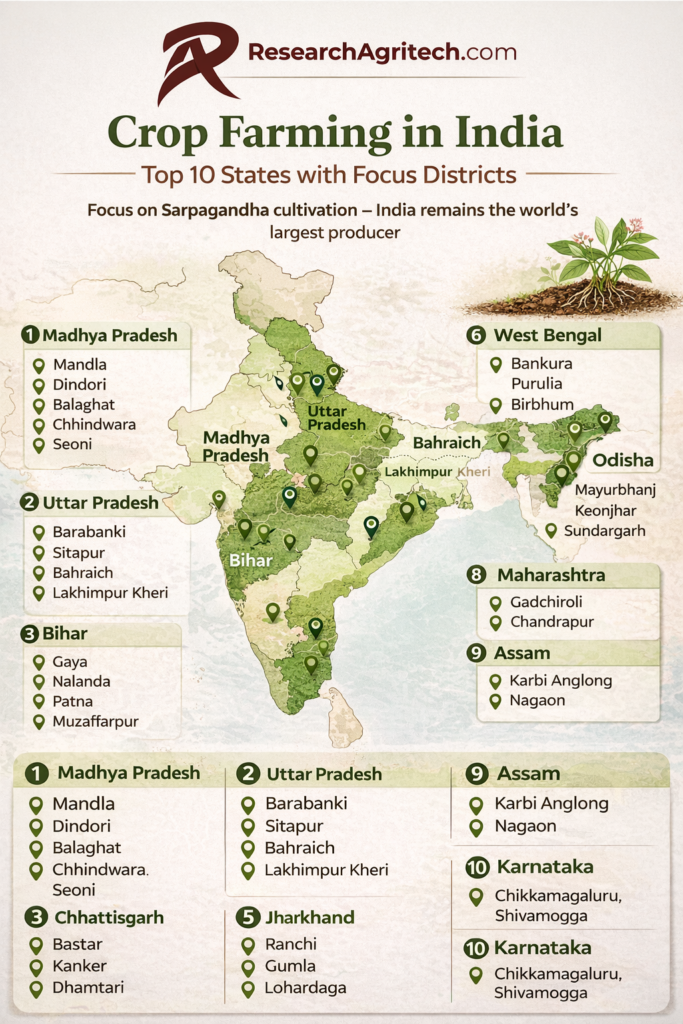
Sarpagandha Crop Farming in India
India is the native home of Sarpagandha and remains the world’s largest producer.
- Madhya Pradesh – Mandla, Dindori, Balaghat, Chhindwara, Seoni
- Uttar Pradesh – Barabanki, Sitapur, Bahraich, Lakhimpur Kheri
- Bihar – Gaya, Nalanda, Patna, Muzaffarpur
- Chhattisgarh – Bastar, Kanker, Dhamtari
- Jharkhand – Ranchi, Gumla, Lohardaga
- West Bengal – Bankura, Purulia, Birbhum
- Odisha – Mayurbhanj, Keonjhar, Sundargarh
- Maharashtra – Gadchiroli, Chandrapur
- Assam – Karbi Anglong, Nagaon
- Karnataka – Chikkamagaluru, Shivamogga
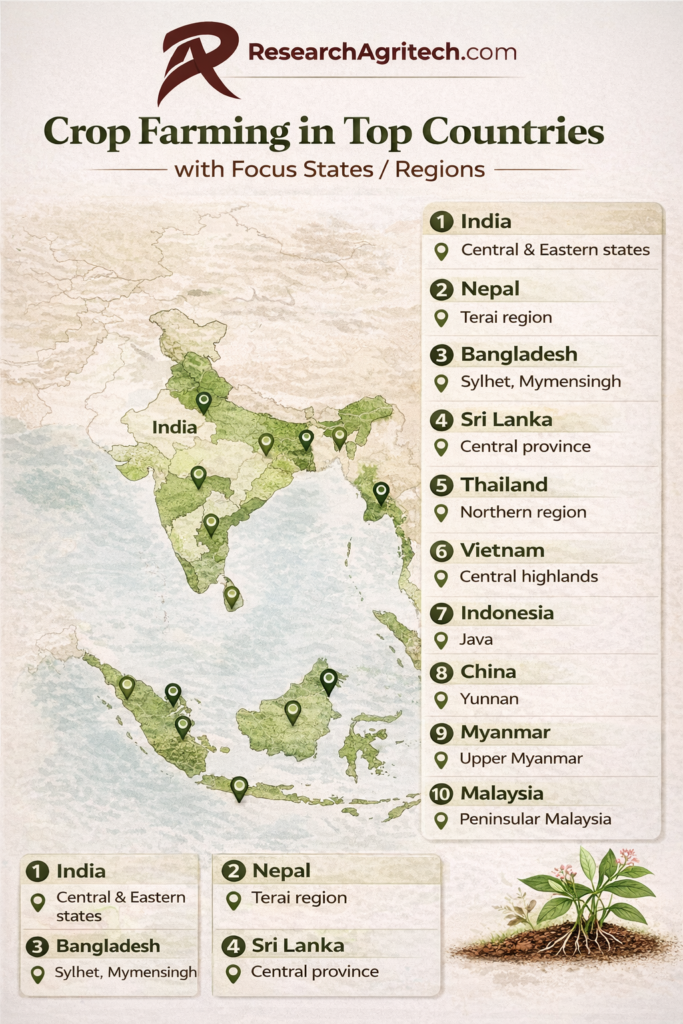
Sarpagandha Crop Farming in Top Countries
- India – Central & Eastern states
- Nepal – Terai region
- Bangladesh – Sylhet, Mymensingh
- Sri Lanka – Central province
- Thailand – Northern region
- Vietnam – Central highlands
- Indonesia – Java
- China – Yunnan
- Myanmar – Upper Myanmar
- Malaysia – Peninsular Malaysia
Sarpagandha Crop Optimal Time for Cultivation
- Nursery raising: February–March
- Transplanting: June–July (with monsoon onset)
- Alternative season: September–October (irrigated areas)
Sarpagandha Crop Climate and Weather Requirements
- Temperature: 20–35°C
- Rainfall: 1000–2000 mm
- Humidity: Moderate to high
- Sensitive to frost and water stagnation
Sarpagandha Crop Field Preparation
- Deep ploughing followed by 2–3 harrowings
- Removal of weeds and stubbles
- Incorporate 10–12 tons FYM per acre
- Prepare raised beds for better drainage
Sarpagandha Crop Soil Requirements
- Soil type: Sandy loam to clay loam
- pH: 6.0–7.5
- Drainage: Well-drained soil essential
Sarpagandha Crop Best Varieties
- CIM-Sheel
- CIM-Medha
- Jawahar Sarpagandha-1
- Jawahar Sarpagandha-2
- Anand Sarpagandha-1
- Anand Sarpagandha-2
- RAU-1
- RAU-2
- Local Forest Selection
- Improved Wild Selection
Sarpagandha Crop Planting Density and Spacing
- Spacing: 45 cm × 30 cm
- Seed rate: 4–5 kg/acre
- Plant population: 30,000–35,000 plants/acre
Sarpagandha Crop Fertilizer Management
Primary Nutrients
- Nitrogen: 40–50 kg/acre
- Phosphorus: 30–35 kg/acre
- Potassium: 20–25 kg/acre
Secondary Nutrients
- Calcium: Improves root growth
- Magnesium: Enhances alkaloid synthesis
- Sulphur: 8–10 kg/acre
Micronutrients
- Zinc, Iron, Boron, Manganese (foliar spray)
Sarpagandha Crop Weeds and Management
- Cyperus rotundus – Manual weeding
- Parthenium – Uprooting
- Amaranthus – Hoeing
- Chenopodium – Mulching
- Digitaria – Intercultivation
- Echinochloa – Hand weeding
- Commelina – Mulching
- Portulaca – Manual control
- Phalaris – Field sanitation
- Eleusine – Mechanical weeding
Sarpagandha Crop Insects and Control
| Insect | Chemical Control | Biological Control |
|---|---|---|
| Aphids | Imidacloprid | Neem oil |
| Whitefly | Thiamethoxam | Yellow traps |
| Thrips | Spinosad | Neem extract |
| Mealybug | Chlorpyrifos | Ladybird beetle |
| Leaf miner | Abamectin | Neem oil |
| Termites | Chlorpyrifos | Neem cake |
| Cutworm | Cypermethrin | Soil solarization |
| Grasshopper | Quinalphos | Mechanical |
| Mites | Dicofol | Predatory mites |
| Beetles | Lambda-cyhalothrin | Neem oil |
Sarpagandha Crop Diseases and Control
| Disease | Chemical Control | Biological Control |
| Leaf spot | Mancozeb | Trichoderma |
| Root rot | Carbendazim | Trichoderma |
| Wilt | Carbendazim | Crop rotation |
| Damping-off | Metalaxyl | Pseudomonas |
| Powdery mildew | Sulphur | Neem extract |
| Leaf blight | Chlorothalonil | Pseudomonas |
| Rust | Propiconazole | Sulphur |
| Collar rot | Copper fungicide | Trichoderma |
| Bacterial leaf spot | Copper oxychloride | Neem extract |
| Mosaic virus | No cure | Rogue plants |
Sarpagandha Crop Harvesting and Yield
- Harvesting time: 18–24 months after planting
- Roots harvested manually after irrigation
Sarpagandha Crop Production Per Acre
- Fresh root yield: 12–15 quintals
- Dry root yield: 4–6 quintals per acre
Conclusion
Sarpagandha farming is a long-duration but highly rewarding medicinal crop with strong domestic and export demand. With scientific practices, proper nutrient management, and assured buyback from pharmaceutical companies, farmers can achieve stable and high returns. Sarpagandha cultivation also supports biodiversity conservation and sustainable medicinal farming in India.

FAQs – Sarpagandha Farming
Q1: What is Sarpagandha?
A1: Sarpagandha (Rauvolfia serpentina) is a medicinal plant used to manage hypertension and mental disorders.
Q2: Which climate is best for Sarpagandha cultivation?
A2: Warm, humid climates with temperatures between 20–35°C and moderate rainfall are ideal.
Q3: What is the best soil for Sarpagandha?
A3: Sandy loam to clay loam soils with pH 6.0–7.5 and good drainage are best.
Q4: When is the optimal planting season for Sarpagandha?
A4: June–July during monsoon is ideal, with an alternative in September–October under irrigation.
Q5: How is Sarpagandha propagated?
A5: Mainly through seeds or stem cuttings for commercial cultivation.
Q6: What is the recommended planting density?
A6: 45 cm × 30 cm spacing with 30,000–35,000 plants per acre.
Q7: What fertilizers are required for Sarpagandha?
A7: Balanced application of NPK, secondary nutrients (Ca, Mg, S) and micronutrients (Zn, Fe, B, Mn).
Q8: How many harvests are possible per cycle?
A8: Roots are usually harvested once after 18–24 months for optimal alkaloid content.
Q9: What is the average root yield per acre?
A9: Fresh roots: 12–15 quintals; Dry roots: 4–6 quintals per acre.
Q10: Which are common weeds in Sarpagandha fields?
A10: Cyperus rotundus, Parthenium, Amaranthus, Chenopodium, Digitaria, and Portulaca.
Q11: How can weeds be controlled?
A11: Through hand weeding, mulching, hoeing, and field sanitation.
Q12: What are the major insect pests of Sarpagandha?
A12: Aphids, whiteflies, thrips, mealybugs, leaf miners, mites, termites, cutworms, grasshoppers, beetles.
Q13: How are insect pests managed?
A13: Using chemical insecticides or biological control like neem oil, predatory mites, and Bt formulations.
Q14: What are common diseases affecting Sarpagandha?
A14: Leaf spot, root rot, wilt, powdery mildew, damping-off, rust, and bacterial leaf spot.
Q15: How are diseases controlled?
A15: Through fungicides, crop rotation, Trichoderma, and removing infected plants.
Q16: Can Sarpagandha be grown organically?
A16: Yes, using organic manure, biopesticides, and organic nutrient sources.
Q17: What is the global demand for Sarpagandha?
A17: High demand exists from ayurvedic, herbal, and pharmaceutical industries worldwide.
Q18: Which Indian states are top producers of Sarpagandha?
A18: Madhya Pradesh, Uttar Pradesh, Bihar, Chhattisgarh, Jharkhand, West Bengal, Odisha, Maharashtra, Assam, Karnataka.
Q19: Is irrigation required for Sarpagandha farming?
A19: Yes, supplemental irrigation ensures proper growth, especially in dry seasons.
Q20: What is the economic potential of Sarpagandha farming?
A20: It is highly profitable due to strong domestic and export demand for roots and raw herbal material.
Writer- Durgaprasad Kewte