Introduction
Insect-pest infestation is one of the major challenges faced by farmers across different agricultural crops. Sucking pests, caterpillars, borers and other insects can damage leaves, stems, flowers and fruits, ultimately affecting crop growth and yield. Best Bayer Solomon Insecticide for Effective and timely pest management is therefore an important part of profitable crop production.
Bayer Solomon is a combination insecticide formulated with two active ingredients—Beta-Cyfluthrin and Imidacloprid—and is designed to provide broad-spectrum insect control through complementary activity.
Its formulation combines the contact and ingestion activity of Beta-Cyfluthrin with the systemic properties of Imidacloprid, providing farmers with a multi-dimensional approach to managing important insect pests.
In this article, we will discuss Bayer Solomon composition, formulation, mode of action, major features, benefits, dosage, application method, precautions and its role in integrated pest management (IPM).

What is Bayer Solomon Insecticide?
Solomon is an insecticide from Bayer formulated using two insecticidal active ingredients:
- Beta-Cyfluthrin – 8.49%
- Imidacloprid – 19.81%
- Formulation – OD (Oil Dispersion)
The combination is intended to provide effective insect control through different biological activities.
Beta-Cyfluthrin belongs to the pyrethroid group, while Imidacloprid belongs to the neonicotinoid group. Because the two ingredients have different insecticidal properties, the formulation can provide complementary action against target insect populations.
For farmers, this combination can be particularly useful when several types of pests are present simultaneously and a broad-spectrum insect management approach is required.
Bayer Solomon Composition & Chemical Ingredients
Understanding an insecticide’s active ingredients is important for selecting the appropriate pest-management product.
Bayer Solomon Composition
| Parameter | Details |
|---|---|
| Product Name | Solomon |
| Active Ingredients | Beta-Cyfluthrin + Imidacloprid |
| Beta-Cyfluthrin | 8.49% |
| Imidacloprid | 19.81% |
| Formulation | OD |
| Category | Insecticide |
| Action | Contact + Systemic |
| Brand | Bayer |
1. Beta-Cyfluthrin
Beta-Cyfluthrin is a pyrethroid insecticide that acts primarily through contact and ingestion. It affects the nervous system of susceptible insects and can provide rapid insecticidal activity.
2. Imidacloprid
Imidacloprid is a systemic insecticide belonging to the neonicotinoid group. It is absorbed by plants and moves through plant tissues. It primarily targets the insect nervous system and is particularly important in the management of several sucking pests.
The combination of these two active ingredients gives Solomon its characteristic dual-ingredient insect-control profile.
Bayer Solomon Mode of Action
One of the important characteristics of Solomon is its dual active-ingredient approach.
Beta-Cyfluthrin – Contact & Ingestion Activity
Beta-Cyfluthrin acts on the nervous system of susceptible insects. Following exposure, it can interfere with normal nerve transmission, leading to loss of coordination, paralysis and eventually death.
Because it has contact activity, insects can be affected when the insecticide comes into contact with their body.
Imidacloprid – Systemic Activity
Imidacloprid is absorbed by plants and interacts with insect nicotinic acetylcholine receptors. This disrupts normal nervous-system function in susceptible insects, resulting in symptoms such as reduced feeding, paralysis and death.
Its systemic nature makes it particularly relevant for managing certain insects that feed on plant tissues and sap.
Why Dual Action Matters
The combination of different active ingredients can provide complementary pest-control activity. However, farmers should not assume that every combination automatically prevents resistance. Effective resistance management requires following the recommended label, rotating or integrating insecticides with appropriate different modes of action, and avoiding unnecessary repeated applications.
Major Features of Bayer Solomon
1. Dual Active Ingredients
Solomon combines Beta-Cyfluthrin and Imidacloprid in one formulation, providing two complementary insecticidal activities.
2. Broad-Spectrum Insect Management
The product can be used against certain sucking and chewing insect pests, depending on the crop and registered label recommendation.
Commonly discussed target pests include:
- Aphids
- Jassids
- Whiteflies
- Thrips
- Caterpillar-type pests
- Certain borers
The exact registered crop-pest combinations should always be checked on the current product label.
3. Quick Insecticidal Activity
The Beta-Cyfluthrin component contributes rapid contact activity against susceptible insects.
4. Systemic Protection
The Imidacloprid component provides systemic insecticidal activity, making the formulation useful against several sucking pests.
5. Convenient Formulation
The OD formulation is designed for dilution and foliar application according to label directions.
6. Multi-Pest Management
Where registered, the combination can help farmers manage more than one important pest type with a single application.
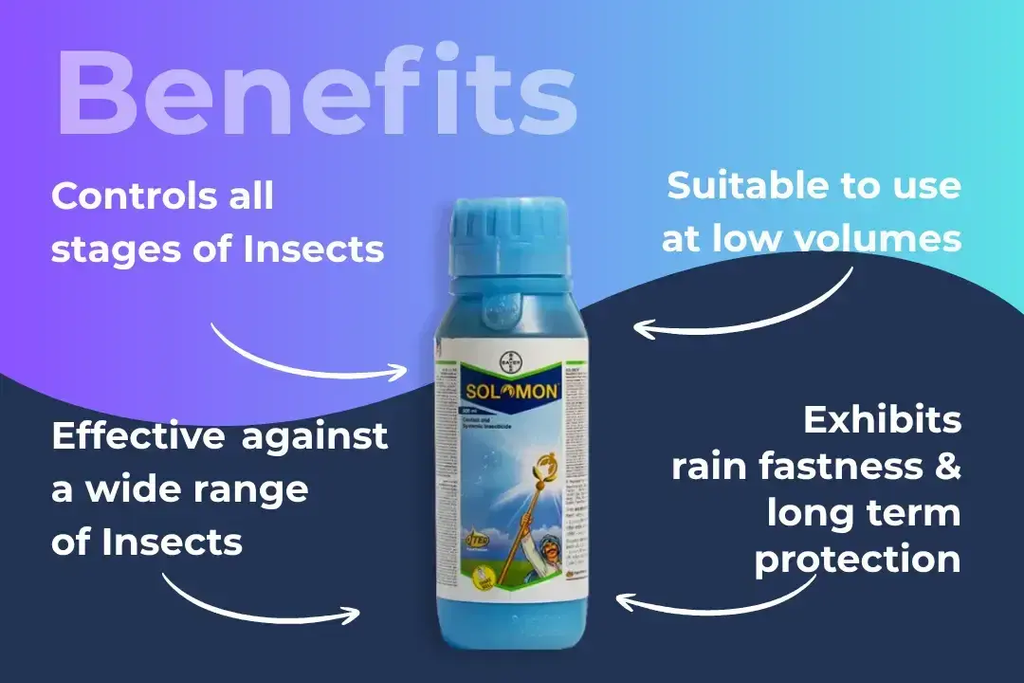
Bayer Solomon Benefits
When used correctly and according to the registered recommendation, Solomon can offer several advantages.
Effective Pest Suppression
The combination of Beta-Cyfluthrin and Imidacloprid provides complementary insecticidal activity and can help suppress susceptible insect populations.
Helps Protect Crop Growth
Early and effective control of damaging insect populations can help reduce feeding damage and support healthier crop development.
Contact + Systemic Activity
The combination provides both contact and systemic insecticidal properties, giving it a broader activity profile than a product based on only one type of activity.
Useful in Integrated Pest Management
Solomon can be incorporated into an IPM program when its use is appropriate for the particular crop and pest.
Potential Economic Benefits
By reducing insect damage and protecting productive plant parts, effective pest management can contribute to maintaining crop yield and quality. Actual economic benefit depends on pest pressure, crop value, application timing and overall production cost.
Bayer Solomon Dosage
The correct dosage is one of the most important aspects of insecticide application.
The information supplied for this article indicates:
General reference dose:
- 1 ml/litre of water
- 15 ml per 15-litre pump
- 150 ml per acre
However, dose recommendations can vary according to crop, target pest, formulation, application method and current registration/label directions.
Therefore, farmers should always use the current Bayer product label as the final authority rather than applying a generalized dose across all crops.
Example Crop-Wise Information
The supplied product information lists the following:
| Crop | Target Pest | Listed Dose/Acre |
|---|---|---|
| Brinjal | Shoot & Fruit Borer, Jassids, Aphids | 80 ml |
| Soybean | Girdle Beetle, Leaf Worm, Semilooper, Stem Fly | 150 ml |
| Other Crops | Jassids, Aphids | 150 ml |
Important: These figures should be treated as supplied reference information and verified against the current registered Bayer label for the specific crop and pest before publication or field recommendation.
Bayer Solomon for Soybean
Soybean is vulnerable to several insect pests during different stages of crop development.
Pests such as stem fly, girdle beetle, semilooper and defoliating caterpillars can affect crop growth and yield when populations reach economically damaging levels.
Solomon is promoted for soybean insect management because its two active ingredients provide complementary insecticidal activity.
However, farmers should follow economic threshold levels (ETLs) and monitor fields regularly rather than applying insecticides automatically.
Important Soybean Management Practices
- Regularly inspect the crop.
- Identify the pest correctly before spraying.
- Monitor pest population and crop damage.
- Apply the recommended insecticide at the appropriate crop stage.
- Avoid unnecessary repeated applications.
- Rotate insecticides according to their mode-of-action groups.
- Preserve beneficial insects wherever possible.
Bayer Solomon for Brinjal
Brinjal can be affected by several important pests, including shoot and fruit borer, jassids and aphids.
Shoot and fruit borer can cause serious economic damage because larvae enter shoots and fruits, making direct control more difficult.
Integrated management should therefore include:
- Regular scouting.
- Removal of severely infested plant parts where practical.
- Monitoring pest population.
- Using recommended insecticides when required.
- Rotating modes of action.
- Maintaining field sanitation.
Where Solomon is registered for the particular crop-pest combination, it may be incorporated into the pest-management program according to the label.
How to Use Bayer Solomon Insecticide?
Correct application is essential for getting the best possible result while minimizing risks.
Step 1: Identify the Pest
Do not spray simply because insects are visible. First identify the pest and determine whether it is an economically important infestation.
Step 2: Read the Product Label
Before application, carefully read the product label for:
- Crop
- Target pest
- Dosage
- Water volume
- Application method
- Waiting period
- Safety precautions
- Personal protective equipment
- Restrictions
Step 3: Measure the Product Accurately
Use a proper measuring device. Avoid estimating the quantity using household utensils.
Step 4: Prepare the Spray Solution
Use clean water and prepare the spray mixture according to the label instructions. Ensure proper agitation and uniform mixing.
Step 5: Wear Protective Equipment
Use appropriate PPE such as gloves, protective clothing, footwear and eye/face protection as specified on the label and safety information.
Step 6: Spray Uniformly
Ensure adequate coverage of the crop canopy, especially the plant parts where the target pest is present.
Step 7: Select the Correct Spray Timing
Application should be made when the target pest is at a susceptible stage and when environmental conditions are suitable.
Avoid spraying during strong winds or immediately before heavy rainfall.
Can a Sticker or Adjuvant Be Used With Solomon?
Adjuvants can sometimes improve spray performance, but they should not automatically be added to every pesticide spray.
If a product such as an agricultural sticker/adjuvant is recommended, farmers should check:
- Label compatibility
- Recommended dose
- Tank-mix compatibility
- Crop safety
- Water quality
- Application conditions
The supplied information mentions IFC Super Sticker as a companion product. Before recommending such a tank mix commercially, verify that the combination is supported by the relevant product labels/manufacturer recommendations.
Precautions While Using Bayer Solomon
Responsible pesticide use is essential for farmer, consumer and environmental safety.
Follow These Precautions
- Read the label before use.
- Use only the recommended dose.
- Do not exceed the label rate.
- Wear appropriate PPE.
- Avoid contact with skin and eyes.
- Do not eat, drink or smoke while handling pesticides.
- Keep children and animals away from the spray area.
- Avoid spraying near water bodies unless permitted and managed according to label requirements.
- Avoid unnecessary applications.
- Follow the prescribed pre-harvest interval.
- Store the product in its original container.
- Never transfer pesticides into food or beverage containers.
- Dispose of empty containers according to local regulations.
Solomon and Resistance Management
Insecticide resistance is becoming an increasingly important challenge in modern agriculture.
Repeatedly applying the same mode of action can select resistant insect populations.
Although Solomon contains two active ingredients with different insecticidal properties, farmers should still follow a resistance-management strategy.
Good Resistance Management Practices
1. Monitor pest populations
Regular field scouting helps determine whether treatment is actually required.
2. Use economic thresholds
Avoid spraying below economically damaging pest levels unless otherwise recommended.
3. Rotate modes of action
Use insecticides from different IRAC mode-of-action groups as part of a planned rotation.
4. Avoid unnecessary repeat sprays
Repeated applications can increase selection pressure.
5. Integrate non-chemical methods
Use cultural, mechanical, biological and other suitable IPM practices.
Role of Solomon in Integrated Pest Management
Integrated Pest Management, or IPM, focuses on managing pests economically while reducing unnecessary pesticide use.
A good IPM program can include:
🌱 Healthy crop establishment
🔎 Regular field scouting
🐞 Conservation of beneficial insects
🦠 Biological control
🌾 Field sanitation
💧 Balanced irrigation and nutrition
🪲 Pest monitoring
🧪 Judicious pesticide application
🔄 Mode-of-action rotation
Solomon should therefore be considered as one tool within a complete pest-management program, rather than as the only solution for every insect problem.
Frequently Asked Questions About Bayer Solomon
Is Solomon a systemic insecticide?
Solomon contains Imidacloprid, which has systemic activity, along with Beta-Cyfluthrin, which provides contact and ingestion activity.
What is the composition of Solomon?
The supplied formulation contains Beta-Cyfluthrin 8.49% + Imidacloprid 19.81% OD.
What is the general dose of Solomon?
The supplied information gives 1 ml/litre, equivalent to 15 ml in a 15-litre pump and 150 ml/acre, but crop-specific label directions should always take priority.
Is Solomon suitable for soybean?
The supplied information lists Solomon for soybean against pests including girdle beetle, leaf worm, semilooper and stem fly. Farmers should verify the current registered label before use.
Can Solomon control sucking pests?
Its Imidacloprid component provides activity against several sucking pests, while Beta-Cyfluthrin provides complementary insecticidal activity.
How often should Solomon be sprayed?
There is no universal spray interval. Application frequency should be based on the registered crop-pest recommendation, pest pressure, monitoring and resistance-management guidelines.
Summary
Bayer Solomon is a combination insecticide containing Beta-Cyfluthrin 8.49% + Imidacloprid 19.81% OD. Its combination of contact, ingestion and systemic insecticidal activity makes it an important option for managing susceptible insect pests in crops where its use is registered.
Its major strengths include dual active ingredients, complementary modes of action, broad insect-control potential and systemic plus contact activity.
However, successful pest management is not simply about choosing a powerful insecticide. Correct pest identification, timely application, accurate dosage, proper spray coverage, crop-stage monitoring and resistance management are equally important.
Farmers should always check the latest product label and legally registered crop-pest recommendations before application. Responsible and need-based pesticide use, combined with IPM practices, can help protect crops while supporting sustainable and profitable farming.
For farmers, the key message is simple: identify the pest first, spray at the right time, use the correct label-recommended dose, protect beneficial insects, and rotate modes of action for long-term pest-management success.
Writer- Durgaprasad Kewte